Challenges of Conventional Domestic Water Heating
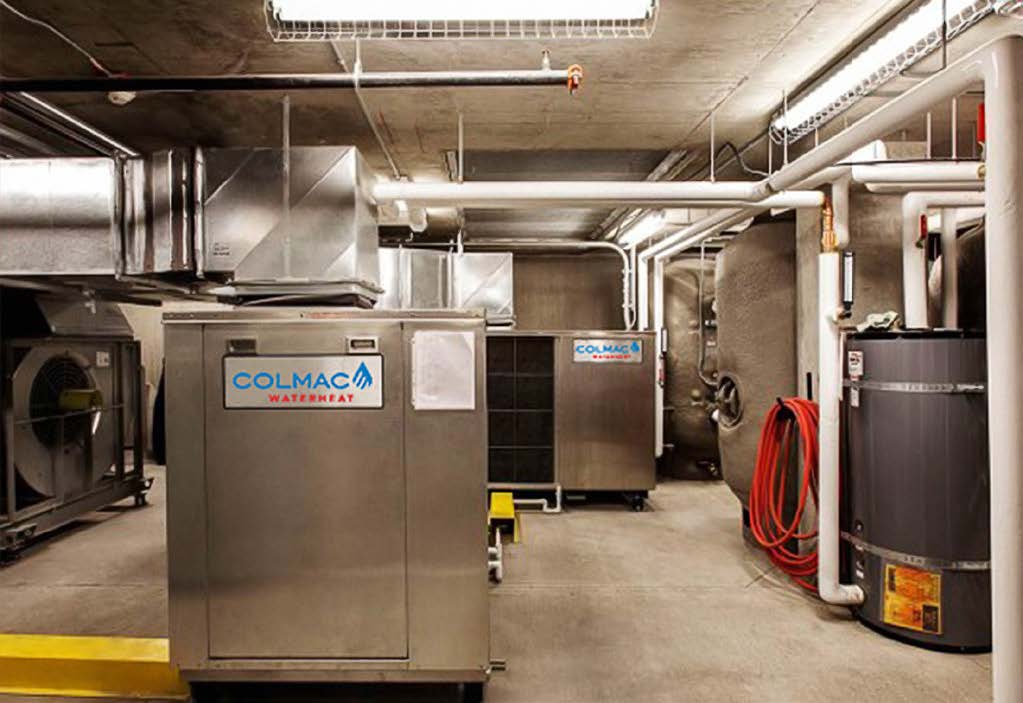 The efficiency gap mentioned above exists because the majority of hot water in New York City is currently produced via conventional gas-fired boilers, which get the job done and take advantage of inexpensive gas rates. These older boilers do not provide any strong efficiencies, but they work, gas is cheap and residents get their hot water.
The problem is that gas-fired boilers produce hot water at a major cost to the environment and energy efficiency. They waste energy, have a low Coefficient of Performance (COP) – meaning they expend a lot of resources to reach the end product – and emit large amounts of CO2. Therefore, they run in direct contrast to New York City’s 80×50 sustainability and electrification plans, which aim to cut greenhouse gas (GHG) emissions by 80% by 2050.[3]
What’s more, gas-fired boilers require major investments on the part of the utility to establish and maintain costly gas lines. The reality is that many new housing projects in New York City will have to be built in areas with undersized gas lines, and in some spots where gas-line installation is impossible, making domestic water heating with natural gas more costly, if even possible.
Challenges Faced by Multifamily Buildings
Multifamily housing is the sector in New York City with one of the greatest needs for domestic hot water. The majority of these buildings run on older non-efficient gas-fired boilers. As a result, domestic water heating accounts for a whopping 22% of GHG emissions from multifamily buildings in New York City.[4]
The needs of multifamily housing are nothing to scoff at since the sector represents over 40% of the total building area and nearly 30% of total GHG emissions in New York City.[5] And with apartment construction at a 30-year high in New York City,[6] multifamily developments are sprouting up across the boroughs, including in some spots with few or no gas lines.
Heat-Pump Water Heaters as the Solution
There’s a better way to provide domestic hot water, and that’s via heat-pump water heaters (HPWH). This technology offers commercial and industrial users of sanitary hot water an energy-efficient means of heating water to temperatures as high as 185°F in a single pass without using any gas.
Electricity-powered heat-pump water heaters use the same operating principle as an air-conditioner or domestic refrigerator. The heat pump gathers heat from the surrounding air, and through the refrigeration cycle, deposits the heat into water at a useable temperature.
This principle of moving heat with a heat pump, rather than generating it by burning fossil fuels or electric resistance, makes water heating with heat pumps the best choice for conserving energy. Depending on the temperature of the source air or water, domestic water can be heated using one-third to one-fourth of the energy required by electric resistance or gas.
In addition, heat-pump water heaters are a strong complement to New York City’s 80×50 plan for building sustainability and electrification. For example, Con Edison is looking into electrification of heating to reduce customer gas demand,[7] and an optimal choice for this goal is heat-pump water heaters.
Results of Implementing Heat-Pump Water Heaters
Implementing electricity-powered heat-pump water heaters in New York City’s buildings will lead to many positive results. These include:
- Significant reduction in energy consumption for domestic water heating.
- The elimination of the need for gas and its accompanying infrastructure to produce domestic hot water.
- Substantial decreases in GHG emissions from buildings.
- Reduced energy and water bills.
- Key support for New York City’s 80×50 building sustainability and electrification initiatives.
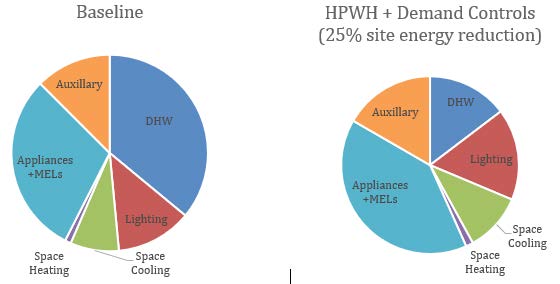
- Up to a 25% reduction in energy use for domestic hot water production,[8] which is shown in the chart below:
Colmac is the Best Choice for Heat-Pump Water Heaters
When deciding on the right heat-pump water heater for the job, the optimal selection is Colmac, one of the world’s leading manufacturers of water-heating heat pumps. Colmac pioneered this technology in the 1980s, and the company is constantly innovating to realize the best products possible.
Here are the reasons why Colmac’s heat-pump water heaters are the best choice:
- Gas-free operations: Colmac heat-pump water heaters are fully electric systems and can achieve a complete domestic hot-water load using the heat pump, without requiring any gas or electric resistance as backup. This means that Colmac systems are in line with the sustainability and building-electrification goals of New York City’s 80×50 plan and Con Edison.
- Improved sustainability: The Colmac high-efficiency vapor compression cycle method has zero direct CO2 or carbon monoxide (CO) emissions. This green, sustainable energy method requires no fossil fuels, and can be a key part of LEED points design and/or qualify for environmental utility incentives.
- Tremendous efficiency: Whereas a conventional gas-fired boiler might have a COP of .95 at the highest end, Colmac systems offer COPs of 3-6, which makes them 300-600% more efficient than a boiler and the most efficient method available today for heating water.
- Lowest energy costs: With heat-pump technology, three to six units of energy are moved from the source to the process water for every input of electrical power. Using ample thermal storage, much of the cost can be shifted to off-peak hours. Further, while heating potable water, the unit creates cool air or cold water, which reduces cooling costs simultaneously.
- Equal total costs: Due to the fact there’s no gas, the gas-piping and flue requirements of boilers are eliminated. This means considerably less construction, equipment and installation costs, thus making total costs equal to a conventional system and payback irrelevant. In some markets, Colmac installation costs are even lower than conventional options.
- Valuable space regained: With zero gas piping and no flue needed, valuable real estate is opened up inside the building that can be used for other revenue-generating uses.
- Easy installation: The unit is modular and can fit through standard-sized doors and elevators in New York City, thus making installation quick and stress-free.
- Code compliance: The unit is built to comply with strict New York City energy codes and fire codes for 15 HP compressor circuits.
- Excelling in New York City weather: The unit is built to handle temperatures as low as -13°F, which is well within the climate extremes of New York City winters.
- Heat recovery and cooling: The unit recovers heat from building exhaust and produces cooling as a byproduct, thus bolstering efficiencies.
- Standard refrigerant use: Instead of hard-to-find, specialty, flammable and dangerous refrigerants used by other manufacturers, Colmac units use refrigerants that are safe and readily available at any HVAC supply store.
- Simple serviceability: Since the unit doesn’t require complex and expensive refrigerant, it’s straightforward to service and maintain.
- Safe, sanitary water: By heating water to 140°-165°F in a single pass, the unit creates a true Hazard Analysis and Critical Control Points (HACCP) step in eradicating Legionella in hot water storage systems, without UV or chemicals. The unit is also certified as safe for potable (sanitary) water with double-wall, vented condensers that fully isolate refrigerant from potable water and prevent cross-contamination.
- Unparalleled reliability: The unit is designed for low maintenance and easy service, with an expected life span of over 15 years.
- Improved occupant safety: In multifamily housing, and in all developments with Colmac systems, safety is improved since gas is no longer needed in the building for producing domestic hot water.
- Centralized or decentralized hot-water production: Colmac’s heat pumps are scalable so that they can be used in large centralized domestic hot-water production and distribution for many apartments. On the opposite end of the spectrum, Colmac offers a small and decentralized heat pump designed to handle the load of a single-family apartment or house.
- Peace of mind: Colmac has been manufacturing and shipping heat-pump water heaters for over 55 years, with many successful air-source installations throughout the coldest climates, such as Canada. The company was the first heat-pump manufacturer to switch from R-22 to R-134a refrigerant, use double wall-vented heat exchangers and output 140°F+ water in a single pass.
In Summary
Domestic water heating via gas-fired boilers in New York City is inefficient, wasteful, costly and polluting. Such antiquated water-heating systems are holding back efficiency efforts and run counter to NYC 80×50 building sustainability and electrification goals. There has to be a better way.
Electricity-powered Colmac heat-pump water heaters are the solution since they don’t use gas and can produce hot water using a quarter of the energy compared to conventional methods. By implementing these systems in New York City, carbon emissions will be substantially curbed and all buildings can take their efficiency performance to the next frontier of sustainability.
For more information on Colmac heat-pump water heaters and their application in New York City, contact HIGHMARK at [email protected] or 212.920.4878.
Richard Gerbe is CEO and Co-Founder of HIGHMARK, a pioneer in building efficiency. HIGHMARK helps engineers, contractors, building owners and building operators who are serious about building efficiency and sustainability by rigorously vetting the best technologies, embracing new innovations and challenging the status quo. For more information, visit: www.highmark-ny.com.

Sources
[1] U.S. Department of Energy, About the Building Technologies Office, http://energy.gov/eere/buildings/about-building-technologies-office.
[2] “Buildings and Climate Change,” U.S. Green Building Council, https://www.eesi.org/files/climate.pdf.
[3] “80 x 50,” NYC Sustainability, https://www1.nyc.gov/site/sustainability/codes/80×50.page.
[4] “Handbook for Multifamily Buildings,” NYC Carbon Challenge, NYC Mayor’s Office of Sustainability, October 2016, http://www.nyc.gov/html/gbee/downloads/pdf/nyc_carbon_challenge_handbook_for_multifamily_buildings.pdf.
[5] “Handbook for Multifamily Buildings,” NYC Carbon Challenge, NYC Mayor’s Office of Sustainability, October 2016, http://www.nyc.gov/html/gbee/downloads/pdf/nyc_carbon_challenge_handbook_for_multifamily_buildings.pdf.
[6] Betsy Kim, “NYC Apartment Construction Highest in 30 Years,” GlobeSt.com, February 27, 2018, https://www.globest.com/2018/02/27/nyc-apartment-construction-highest-in-30-years/.
[7] “Gas Demand Response Pilot Implementation Plan, 2018-2021,” Con Edison, April 26, 2018, http://documents.dps.ny.gov/public/Common/ViewDoc.aspx?DocRefId=%7B22BB3E67-11BC-445F-AE14-3DBB8568A0D0%7D.
[8] New York Passive House event on heat-pump water heaters.
