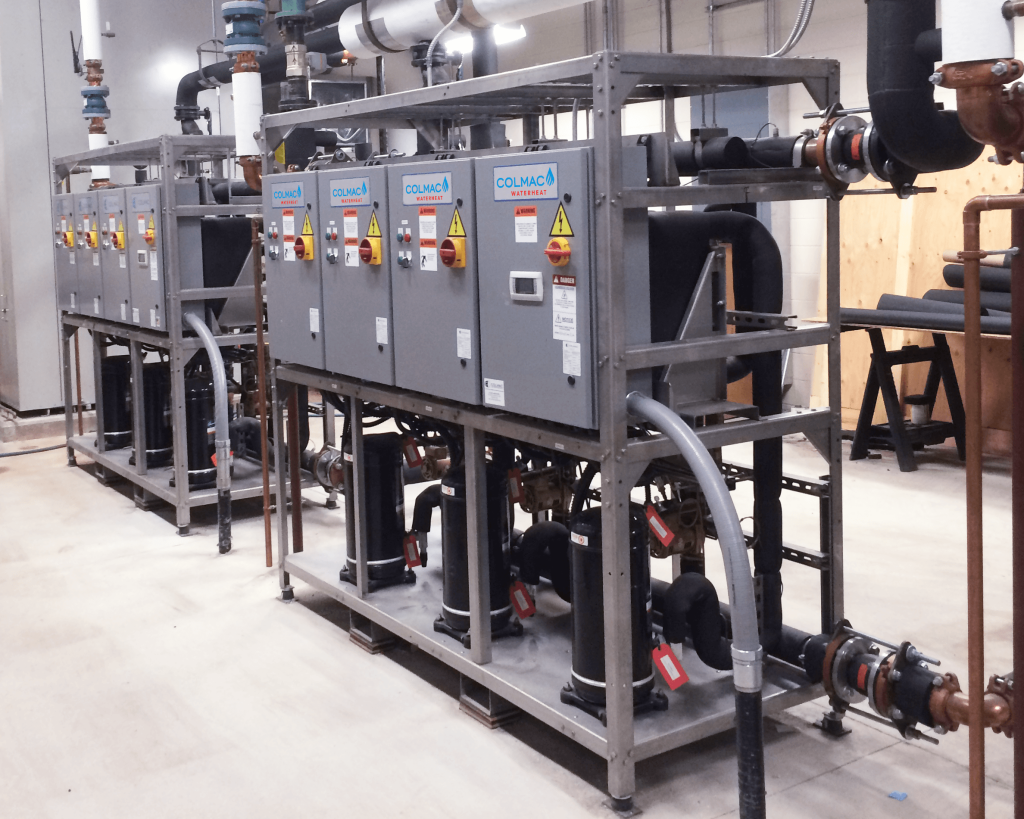
Heat-Pump Water Heaters – the Next Frontier of Sustainability
Heat-pump water heaters are the most viable carbon-free solution for domestic hot water, and can help make ambitious sustainability, electrification and decarbonization goals a reality.
This article originally appeared in BuildingEnergy magazine, Fall 2019:

Situation Overview: Why Heat-Pump Water Heaters?
The commercial and residential building sector consists of many structures that are energy inefficient, resulting in serious pollution, global warming and supply challenges. These buildings are responsible for approximately 40% of the energy and 70% of the electricity used annually in the U.S.[1], and 39% of the carbon dioxide (CO2) emitted each year in the nation.[2]
Although steps are being taken to make buildings more efficient, such as better lighting, ventilation and air tempering, these efforts don’t cover all building-efficiency opportunities. Initiatives are falling short in one main area – domestic water heating – and making up this deficit can push building efficiency to new levels. This is the next frontier of building sustainability.
Heat-pump water heaters (HPWHs) provide a relatively simple solution to resolve the shortfalls of water heating in most buildings. When combined with electricity supplied by renewables, these systems support carbon-reduction efforts, such as New York City’s 80×50 plan to cut greenhouse-gas (GHG) emissions 80% by 2050[3] and Boston’s goal to be carbon-neutral by 2050.[4]
Utilizing electric heat-pump water heaters can bolster the efficiency and sustainability of all buildings currently using fossil fuels to heat water. Higher efficiency, using grid power that is becoming cleaner and decreasing the costs of renewable energy make heat-pump water heaters an option that we must embrace to meet our carbon-reduction goals.
Challenges of Conventional Domestic Water Heating
Domestic water heating poses sustainability challenges because the majority of hot water in North American cities is produced via conventional gas-fired heaters. These older systems waste energy, have a low coefficient of performance (COP) since they expend considerable energy to heat water and emit large amounts of CO2. Therefore, they are in direct contrast to carbon-reduction initiatives.[5]
Further, gas-fired heaters require extensive investments by utilities to establish and maintain costly gas lines. The reality is that many new urban housing projects, particularly multifamily buildings, will be built in areas with undersized gas lines and in some parts where gas lines aren’t feasible.
Multifamily Buildings Face Many Hurdles
Domestic hot water poses acute challenges for multifamily buildings due to sizeable hot-water needs and a reliance on fossil fuels,[6] which is a big problem for the environment. Hot water alone is responsible for 22% of the greenhouse-gas emissions discharged by New York City’s multifamily buildings.[7]
The energy needs of multifamily housing are significant. For example in New York City, the sector represents over 40% of the total building area and nearly 30% of greenhouse-gas emissions.[8] With apartment construction at a 30-year high in the city,[9] multifamily developments are sprouting up everywhere.
Electric Heat-Pump Water Heaters as the Solution
There’s a better way to provide domestic hot water, and that’s via electric heat-pump water heaters. This technology offers commercial, residential and industrial users of sanitary hot water an energy-efficient means of heating water to temperatures as high as 185°F in a single pass, without using any natural gas.
Electric heat-pump water heaters use the same operating principle as an air-conditioner or domestic refrigerator. The heat pump gathers energy from the surrounding air, and, through the refrigeration cycle, deposits the energy into water at a useable temperature.
Moving energy with a heat pump, rather than generating it via fossil fuels or electric resistance, makes heat-pump water heaters the best energy-conservation choice. Depending on the temperature of the source air or water, domestic water can be heated using one-third to one-fourth of the energy required by electric resistance or gas.
Electric heat-pump water heaters are a strong complement to carbon-reduction programs being adopted in many cities in the Northeast and across North America. So much so that utilities, such as New York’s Con Edison, are increasingly eyeing electrification of domestic water heating as a way to reduce customer gas demand.[10]
No technology is without challenges, and heat-pump water heaters can have higher upfront costs than conventional water heaters; however, heat-pump water heaters also have lower operating costs that offset initial expenses.[11] Also, this technology historically was less efficient in colder temperatures, but advances have enabled them to excel in cold climates.
Results of Utilizing Heat-Pump Water Heaters
Implementing electric heat-pump water heaters will lead to many positive results, including:
- No gas: Electric heat-pump water heaters eliminate all gas needs for domestic water heating.
- Fewer carbon emissions: Carbon emissions, and all greenhouse-gas emissions, from buildings are reduced.
- Downsized HVAC equipment: Eliminating the complex infrastructure associated with gas enables HVAC equipment to be minimized.
- Furthering decarbonization efforts: Key support is provided for carbon-reduction initiatives throughout the Northeast and North America.
- Increased efficiency: The amount of energy transferred by electric heat pumps can be three or four times larger than the power consumed, thus giving heat pumps a COP of 3-4, as opposed to just 1 for electric-resistance water heaters (ERWHs).[12] The best gas-fired boiler fares even worse with an efficiency rating of .90.[13] In other words, heat pumps are 300-400% more efficient than electric-resistance water heaters or gas boilers.
- Massive cost savings: The U.S. Department of Energy (DOE) found that if all electric-resistance water heaters were replaced with heat-pump water heaters in the U.S., commercial buildings would save $1.5 billion[14] and residences $7.8 billion in annual costs.[15] See the chart below for more details:

ource: DOE[16]
In Summary
Domestic water heating via conventional heaters is inefficient, costly and polluting. Such antiquated systems are holding back efficiency efforts and run counter to decarbonization goals dependent on more efficient and sustainable buildings. There has to be a better way to heat water in our commercial, residential and institutional buildings.
Electric heat-pump water heaters are the solution since they don’t use gas and can produce hot water using a quarter of the energy used by traditional equipment. By implementing these systems in North American cities, carbon emissions will be substantially curbed and all buildings can take their efficiency performance to the next frontier of sustainability.
[1] “About the Building Technologies Office,” U.S. Department of Energy, http://energy.gov/eere/buildings/about-building-technologies-office.
[2] “Buildings and Climate Change,” U.S. Green Building Council, https://www.eesi.org/files/climate.pdf.
[3] “80 x 50,” NYC Sustainability, https://www1.nyc.gov/site/sustainability/codes/80×50.page.
[4] “REDUCING EMISSIONS,” City of Boston, Mayor Martin J. Walsh, Department of the Environment, https://www.boston.gov/departments/environment/carbon-free-boston.
[5] “80 x 50,” NYC Sustainability, https://www1.nyc.gov/site/sustainability/codes/80×50.page.
[6] “NEW YORK CITY’S ENERGY AND WATER USE 2013 REPORT,” The City of New York, Mayor Bill de Blasio, Mayor’s Office of Sustainability, August 2016, https://www.urbangreencouncil.org/sites/default/files/nyc_energy_water_use_report_2016.pdf.
[7] “NYC Carbon Challenge Handbook for Multifamily Buildings,” New York City Mayor’s Office of Sustainability, October 2016, http://www.nyc.gov/html/gbee/downloads/pdf/nyc_carbon_challenge_handbook_for_multifamily_buildings.pdf.
[8] Ibid.
[9] Betsy Kim, “NYC Apartment Construction Highest in 30 Years,” GlobeSt.com, February 27, 2018, https://www.globest.com/2018/02/27/nyc-apartment-construction-highest-in-30-years.
[10] “Gas Demand Response Pilot Implementation Plan, 2018-2021,” Con Edison, April 26, 2018, http://documents.dps.ny.gov/public/Common/ViewDoc.aspx?DocRefId=%7B22BB3E67-11BC-445F-AE14-3DBB8568A0D0%7D.
[11] “Heat Pump Water Heaters,” Energy Saver, U.S. Department of Energy (DOE), https://www.energy.gov/energysaver/water-heating/heat-pump-water-heaters.
[12] “Heat pump,” Wikipedia, https://en.wikipedia.org/wiki/Heat_pump.
[13] “Types of Heating Systems,” SmarterHouse, https://smarterhouse.org/heating-systems/types-heating-systems.
[14] “HEAT PUMP WATER HEATERS,” Better Buildings Initiative, U.S. Department of Energy, https://betterbuildingsinitiative.energy.gov/heat-pump-water-heaters.
[15] Carl Shapiro and Srikanth Puttagunta, “Field Performance of Heat Pump Water Heaters in the Northeast,” U.S. Department of Energy, Office of Energy Efficiency & Renewable Energy, February 2016, https://www.nrel.gov/docs/fy16osti/64904.pdf.
[16] Two sources were used to compile this chart: 1) “HEAT PUMP WATER HEATERS,” Better Buildings Initiative, U.S. Department of Energy, https://betterbuildingsinitiative.energy.gov/heat-pump-water-heaters and 2) Carl Shapiro and Srikanth Puttagunta, “Field Performance of Heat Pump Water Heaters in the Northeast,” U.S. Department of Energy, Office of Energy Efficiency & Renewable Energy, February 2016, https://www.nrel.gov/docs/fy16osti/64904.pdf.
