A strong design is incomplete without implementing proper water-filtration technologies. Thus, this begs the question – what’s effective water filtration for a mechanical system? Not surprisingly, it depends on who you ask.
Therefore, to demystify water filtration in mechanical systems, HIGHMARK created this guide. The goals are to highlight the minimum filter requirements and recommend the most energy- and water-efficient solutions.
The Criticality of Water Filtration
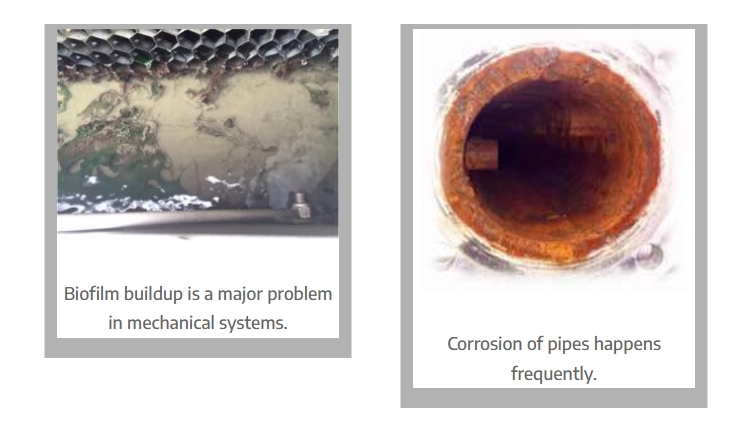
The importance of filtration in air systems is easily understood. However, when it comes to water filtration, it tends to be a bit murky. To clear the water, particle contamination can cause inefficiencies in the system, not to mention fouling or bio-film build-up and acid erosion, which shortens the equipment’s lifetime.
As such, cutting out adequate filtration to save money now can end up costing more in the future. Moreover, in open-loop systems, the costs to the community are far worse. This is because of the potential of a Legionella outbreak due to inadequate filtration.
Local Law 77 Requirements
In August of 2015, NYC officials responded with Local Law 77. This was after several Legionella outbreaks and nearly half of the inspected cooling towers in the city testing positive for Legionella.
Consequently, this code requires all cooling towers, evaporation condensers and fluid coolers to be registered with the Department of Health and Mental Hygiene. Further, the systems must follow a maintenance program in compliance with ASHRAE Standard 188P. Ultimately, this demonstrates the importance of utilizing water-filtration technologies.
Few moving parts (no electric motors, gearboxes, limit switches or pistons)
Simple controls
Flush waste is less than 1% of system flow
Strong cleaning efficiencies
Lower maintenance requirements
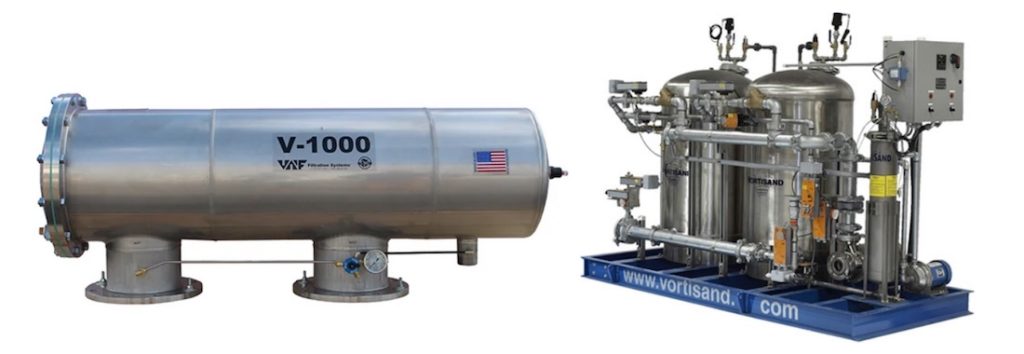
Vortisand High-Efficiency Microsand Filters
High-capacity media filter that combines cross-flow dynamics with microsand media to achieve submicron filtration performance
This technology allows the unit to operate at filtration rates of up to 4 times greater than those of traditional media filters, while filtering 10-50 times finer
The high-capacity filter reduces water consumption, saves energy, reduces chemical costs and has minimal maintenance requirements
Let’s create a more sustainable world.
Our team partners with engineers, contractors, owners and operators across all commercial and high-rise residential building types. We customize our building efficiency technologies for every job to meet the specific needs of the most demanding structures.